
Carrier Scorecards: A Practical Guide for Pharmaceutical Logistics Teams

By Mike Broeckling, VP of Operations, Alpha Zero Logistics
Pharmaceutical supply chains operate under conditions that leave almost no margin for carrier error. A single temperature excursion can render a shipment unusable. A late delivery to a clinical trial site can delay enrolment. A lost pallet of controlled substances triggers regulatory reporting obligations that consume weeks of compliance work. Against that backdrop, choosing carriers based on rate cards alone is no longer viable, and yet many pharmaceutical logistics teams still rely on patchy spreadsheets and instinct when assessing carrier performance.
A structured carrier scorecard solves this problem. It converts subjective impressions into measurable performance data, supports defensible carrier selection decisions, and gives quality and compliance teams an audit trail that holds up under regulatory scrutiny. Whether a team manages its carrier base directly or works through an outsourced transportation programme, this guide outlines how pharmaceutical logistics teams can design, populate, and act on carrier scorecards that reflect the regulatory, clinical, and commercial realities of life sciences freight.
Why Pharmaceutical Logistics Demands a Different Approach
Most carrier scorecards in general freight environments measure the basics: on-time pickup, on-time delivery, claims ratio, invoice accuracy, and tender acceptance. Those metrics matter in pharma too, but they do not capture the risks that define life sciences distribution. A carrier with a 98 per cent on-time rate is still a poor partner if a quarter of those shipments arrive outside the validated temperature range. A carrier with a flawless claims record may still be unsuitable if the team cannot produce GDP-compliant training records on request.
Pharmaceutical scorecards therefore need to layer regulatory, qualification, and cold-chain performance metrics on top of standard operational measures. The structure should reflect the priorities of the products being shipped, whether that means biologics requiring deep-frozen handling, controlled substances demanding chain-of-custody documentation, or commercial finished goods moving through traditional ambient lanes.
Core Categories Every Scorecard Should Cover
A well-designed pharmaceutical carrier scorecard typically organises metrics into five categories. Each category should carry a defined weight, and each metric within it should have a clear measurement method and data source.
Operational Performance
This is the foundation. Metrics include on-time pickup, on-time delivery, transit time variance against contracted standards, tender acceptance rate, and dwell time at origin and destination. For pharmaceutical lanes, transit time variance often deserves more attention than headline on-time percentages because consistency matters more than averages when shelf-life calculations depend on predictable handling windows.
Cold Chain and Product Integrity
Temperature excursion rate is the headline metric, but it should be broken down further. Useful sub-metrics include the percentage of shipments with continuous data logger coverage, mean kinetic temperature deviation, time-to-temperature-recovery after excursions, and packaging return rates for reusable containers. Lane-level segmentation matters here. A carrier may perform well on regional 2-8°C lanes but struggle with deep-frozen long-haul moves, and a single aggregate score will hide that pattern.
The stakes in this category are not abstract. According to research published by the IQVIA Institute, the pharmaceutical industry loses approximately $35 billion annually from temperature-related product losses. That number makes a compelling case for treating cold-chain metrics as the core of any scorecard, not a secondary consideration layered on top of standard delivery data.
Regulatory and Quality Compliance
This category captures the documentation that quality assurance teams depend on. Metrics should include audit findings closure rate, training record currency for handling staff, GDP qualification status, deviation reporting timeliness, and CAPA completion against agreed deadlines. For controlled substances, additional measures cover DEA documentation accuracy and chain-of-custody completeness.
The documentation burden in this category is growing, not shrinking. Industry data from Mordor Intelligence indicates that 85% of US clinical studies in 2024 incorporated at least one decentralized element, multiplying the number of hand-off points that require documented temperature control and chain-of-custody records. Carriers serving clinical lanes need to be evaluated against that reality, not just against the documentation expectations of traditional depot-to-site distribution.
Financial and Administrative Performance
Invoice accuracy, billing dispute resolution time, accessorial charge ratios, and rate adherence belong here. Pharmaceutical shippers often discover that carriers with strong operational metrics still erode margins through inconsistent billing, particularly when fuel surcharges, detention fees, and after-hours delivery charges are not clearly tied to contracted terms.
Service and Communication
Soft metrics matter when something goes wrong, which in pharmaceutical logistics is when carrier quality becomes most visible. Useful measures include average response time to exception alerts, escalation pathway clarity, proactive notification rates for in-transit issues, and quarterly business review attendance and content quality.
Setting Weights That Reflect Risk
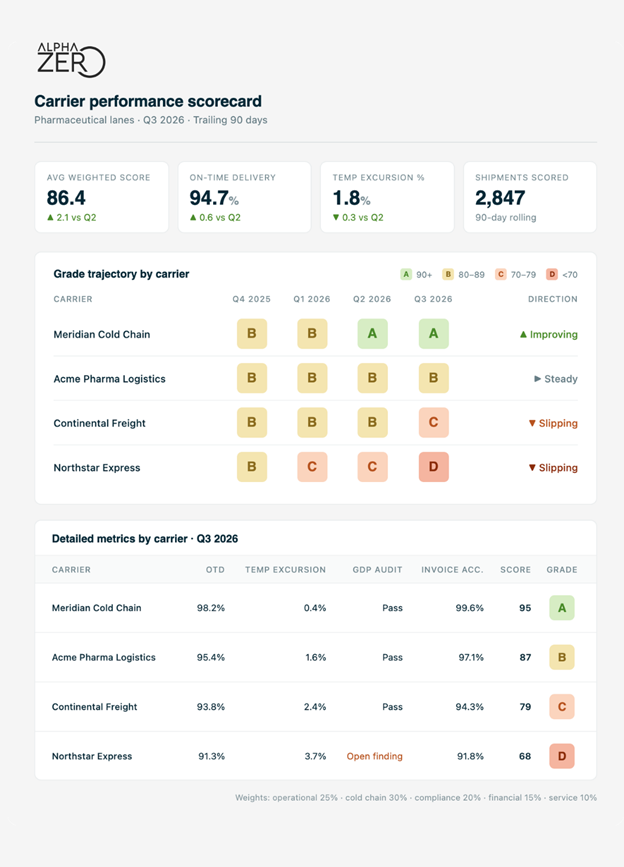
The most common mistake in scorecard design is applying equal weights across categories. A pharmaceutical scorecard should weight categories according to the risk profile of the products and lanes involved. A reasonable starting framework for finished-goods commercial distribution might place operational performance at 25 per cent, cold chain integrity at 30 per cent, regulatory compliance at 20 per cent, financial performance at 15 per cent, and service at 10 per cent. Clinical trial logistics typically shifts more weight toward regulatory compliance and service, given the consequences of patient site delays and the documentation demands of sponsor quality teams.
Weights should be reviewed annually, or whenever the product portfolio changes meaningfully. The introduction of a new biologic, the addition of a controlled substance line, or expansion into emerging markets all warrant reassessment.
Data Sources and Measurement Discipline
Scorecard credibility lives or dies on data quality. Pharmaceutical logistics teams should map each metric to a defined data source before rolling out the scorecard. Common sources include transportation management systems for tender and delivery data, data logger platforms for temperature performance, quality management systems for audit and CAPA records, and accounts payable systems for invoice metrics.
Manual data entry should be minimised. Where it is unavoidable, ownership should be explicit and verification cycles defined. Carrier-reported metrics should always be cross-checked against shipper-side data, and discrepancies should themselves become a tracked metric.
The measurement period also matters. Monthly rolling averages tend to obscure recent performance shifts, while purely monthly snapshots overreact to small sample sizes on lower-volume lanes. A combination of trailing three-month and trailing twelve-month views tends to give the most actionable picture.
Turning Scores into Action
A scorecard that nobody acts on is administrative theatre. The point of measurement is to drive behaviour, both inside the carrier base and within the shipper’s own organisation.
Performance bands should be defined upfront. A common structure uses tiers such as preferred, approved, conditional, and at-risk, with clear criteria for movement between tiers. Carriers in the preferred tier might receive priority tendering and volume growth opportunities. Conditional carriers should have documented improvement plans with measurable milestones. At-risk carriers should face defined off-boarding timelines unless specific recovery thresholds are met within an agreed window.
Quarterly business reviews are the natural forum for scorecard discussions, but the conversation should not begin there. Routine performance data should flow to carriers monthly, ideally through a shared dashboard, so that quarterly reviews focus on trend interpretation and improvement planning rather than data reconciliation.
Common Pitfalls
Several patterns recur in pharmaceutical carrier scorecards that undermine their value.
The first is metric proliferation. Scorecards that track forty or fifty measures dilute attention and create reporting burden that exceeds the insight produced. A focused scorecard with twelve to fifteen well-chosen metrics usually outperforms a comprehensive one.
The second is failure to segment by lane or product type. Aggregate scores penalise carriers for performance on lanes they were never well-suited to and reward them for averages that hide critical lane-level failures.
The third is treating the scorecard as a procurement tool rather than a partnership tool. The most useful scorecards are shared transparently with carriers, including the weighting logic and improvement thresholds. Carriers that understand exactly how performance is measured tend to invest in the right capabilities, while those operating against opaque criteria often optimise for the wrong things.
The fourth is neglecting internal performance. Carrier scorecards should be paired with shipper-side metrics covering tender lead time, dock scheduling accuracy, and documentation completeness. Many performance issues attributed to carriers originate upstream, and a scorecard that ignores this reality erodes trust and produces poor decisions.
When Internal Capability Reaches Its Limits
Building and maintaining a rigorous pharmaceutical carrier scorecard requires sustained effort across logistics, quality, finance, and IT. For larger pharmaceutical shippers with mature transportation organisations, this investment is justified by direct control and institutional knowledge. For mid-sized manufacturers, contract development and manufacturing organisations, and emerging biotechs, the resource demand often exceeds available capacity.
Capacity constraints compound the problem. According to the American Trucking Associations, as cited in Mordor Intelligence’s US pharmaceutical logistics analysis, the industry faced an estimated 78,000-driver shortfall in 2024, with pharmaceutical lanes requiring hazmat certification, temperature-controlled experience, and security clearances shrinking the qualified pool even further. For organisations without dedicated carrier management resources, maintaining scorecard programmes that account for this kind of lane-level supply risk becomes increasingly difficult to do well internally.
In these situations, working with a qualified transportation management partner can deliver the analytical infrastructure, carrier governance frameworks, and reporting cadence that a robust scorecard programme requires, without the internal headcount investment. The right partner brings established carrier networks, qualification documentation, and performance management systems that have already been validated against pharmaceutical standards, allowing logistics teams to focus on strategic decisions rather than data assembly.
Building Toward Continuous Improvement
A carrier scorecard is not a static document. Pharmaceutical supply chains evolve as products move through their lifecycles, as regulatory expectations shift, and as carrier capabilities mature. The scorecard should evolve with them.
Annual reviews of metrics, weights, and performance thresholds keep the tool aligned with current priorities. Cross-functional input from quality, regulatory, finance, and commercial teams ensures that the scorecard reflects the full range of stakeholder requirements rather than logistics priorities alone. And periodic benchmarking against industry peers, where data is available through trade associations or third-party studies, provides external calibration that internal data cannot.
Done well, a carrier scorecard becomes more than a measurement tool. It becomes the central artefact through which a pharmaceutical logistics organisation expresses its standards, manages its risk, and builds the carrier relationships that ultimately determine whether products reach patients safely and on time.
Author Bio:

Mike Broeckling
Director of Operations, Alpha Zero Logistics
Mike Broeckling is the Director of Operations at Alpha Zero Logistics, where he brings over a decade of leadership experience in Fourth Party Logistics and managed transportation. With a background spanning carrier procurement, operational strategy, and supply chain solutions, he focuses on helping shippers with complex networks improve service reliability, reduce costs, and scale efficiently.
 Media Pack Download
 Newsletters
 Industrial Events