Pharmaceutical Formulation Development: A Complete Guide
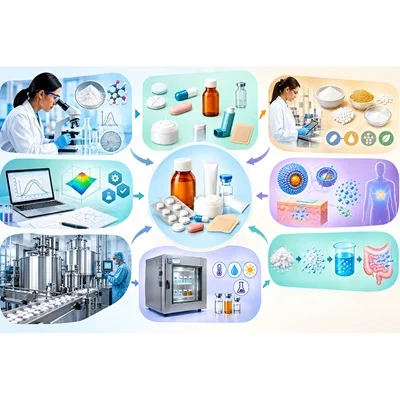
Quick answer: Pharmaceutical formulation development is the process of combining an active pharmaceutical ingredient (API) with carefully chosen excipients to create a dosage form that is safe, stable, effective, and easy to manufacture. It runs from preformulating studies through design, optimization, stability testing, and scale-up.
A drug molecule on its own is rarely a medicine. Think of paracetamol powder: you can’t hand someone a pinch of it and expect a consistent, safe dose. It has to become a tablet, syrup, or injection first. That transformation is what formulation development is about, and it’s where a lot of promising drugs quietly succeed or fail.
This guide walks through the whole journey in plain language, whether you’re a pharmacy student, an R&D scientist, or someone entering the industry.
What Is Pharmaceutical Formulation Development?
Pharmaceutical formulation development is the science of turning an API into a finished product patients can actually use. The API provides the therapeutic effect. The excipients (binders, fillers, disintegrants, preservatives, solvents) make the product stable, deliverable, and acceptable to the patient.
A good pharmaceutical formulation has to do four things:
- Deliver the correct dose every single time
- Stay stable through its shelf life
- Release the drug where and when it’s needed
- Be practical to manufacture at scale
Get one of these wrong and the best molecule in the world becomes a poor product.
Where Does Formulation Fit in the Drug Development Process?
The drug development process usually moves through discovery, preclinical testing, clinical trials (Phases I to III), regulatory review, and post-market surveillance. Formulation work runs alongside almost all of it, and it evolves as the project does.
Early on, scientists often use a simple formulation (a solution or capsule) just to get the drug into animals or first-in-human studies. As the program matures, the formulation gets refined into the final commercial product. A late change can force extra bioequivalence studies, so the smartest teams invest in formulation thinking early.
Step 1: Preformulating Studies
Preformulating studies are the foundation. Before choosing a dosage form, you need to understand the API’s behavior. Skip this and you’ll pay for it later in failed batches.
Key preformulation checks include:
- Solubility and pH profile: How well does the drug dissolve at different pH levels, such as stomach versus intestine?
- Partition coefficient (LogP): Does it prefer water or fat, which hints at how it crosses membranes?
- Particle size and polymorphism: Different crystal forms can dissolve at very different rates.
- Hygroscopicity: Does it absorb moisture from air?
- Drug-excipient compatibility: Will the API react with the ingredients you plan to use?
- Chemical stability: How does it respond to heat, light, oxygen, and humidity?
Many teams also classify the drug using the Biopharmaceutics Classification System (BCS), which sorts drugs by solubility and permeability. A BCS Class II drug (low solubility, high permeability) will need a very different strategy from a Class I drug.
Step 2: Choosing the Right Dosage Form
Dosage forms are the final physical shape in which a drug reaches the patient. The choice depends on the drug’s properties, the target condition, and who will take it.
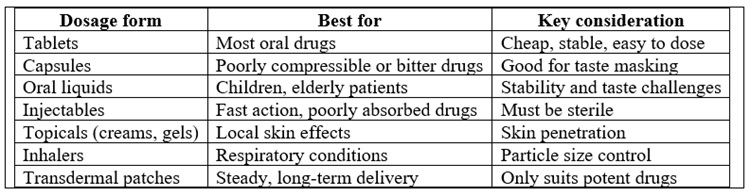
Patient compliance matters here more than people expect. A dose that’s hard to swallow or tastes terrible won’t be taken, no matter how elegant the science.
Step 3: Excipient Selection and Formula Design
Excipients are often called “inactive,” which is a bit misleading. They shape how the drug behaves. A disintegrant decides how fast a tablet breaks apart. A coating can protect the drug from stomach acid. A surfactant can rescue a poorly soluble compound.
Formulators typically use Quality by Design (QbD) principles here. Instead of testing by trial and error, they identify critical quality attributes (CQAs) and critical process parameters (CPPs), then use Design of Experiments (DoE) to find a robust formula efficiently. Regulators encourage this approach because it builds quality in rather than testing it in afterward.
Modern Drug Delivery Systems
Conventional tablets and injections are still the workhorses, but advanced drug delivery systems are changing what’s possible:
- Controlled and extended-release systems keep drug levels steady and reduce dosing frequency.
- Targeted delivery sends the drug mainly to the diseased tissue, reducing side effects.
- Liposomes and nanoparticles carry drugs through the body and protect fragile molecules.
- Transdermal and microneedle systems deliver medicine through the skin without a hypodermic needle.
- Orally disintegrating tablets dissolve on the tongue, helping patients who struggle to swallow.
These systems add complexity, but they can turn a mediocre molecule into a much better therapy.
Bioavailability Enhancement: Making Drugs Work Better
Bioavailability is the fraction of a drug that reaches the bloodstream in active form. A large share of new drug candidates dissolve poorly in water, which limits absorption. That’s why bioavailability enhancement is one of the most active areas in formulation science.
Common strategies include:
1. Particle size reduction (micronization, nanosizing): More surface area means faster dissolution.
2. Solid dispersions: The drug is dispersed in a polymer carrier, often in an amorphous (higher-energy) state.
3. Lipid-based formulations (SEDDS/SMEDDS): The drug stays dissolved in oils and surfactants until absorbed.
4. Cyclodextrin complexation: Cyclodextrins form molecular “cages” that improve solubility.
5. Salt and co-crystal formation: Changing the solid form improves dissolution without altering the molecule.
6. Prodrugs: A chemically modified version converts to the active drug in the body.
The right approach depends on the preformulation data, which is why those early studies matter so much.
Formulation Stability Studies
A product that works on day one but degrades in six months is a failed product. Formulation stability studies prove that a drug keeps its quality, safety, and potency throughout its shelf life.
These studies generally follow ICH guidelines (Q1A and related documents) and include:
- Long-term testing: Samples stored under recommended conditions for the proposed shelf life.
- Accelerated testing: Higher temperature and humidity (for example, 40°C and 75% RH for six months) to predict long-term behavior.
- Stress testing (forced degradation): Harsh conditions that reveal how and why the drug breaks down.
- Photostability testing: Exposure to light to decide whether protective packaging is needed.
Stability data decides the shelf life, storage instructions, and packaging. In many regions, including India, climatic zone requirements affect the conditions you must test under, so check the regulations for your target markets.
Scale-Up and Technology Transfer
A formula that works beautifully in a 1-liter lab batch can behave differently in a 1,000-liter reactor. Mixing times, heat transfer, and compression forces all change with scale. Successful teams run pilot batches, document every parameter, and transfer the process to manufacturing with clear specifications. Following Good Manufacturing Practice (GMP) throughout isn’t optional.
Common Challenges in Formulation Development
- Poor aqueous solubility of new chemical entities
- Drug-excipient incompatibility discovered late
- Stability problems under hot, humid conditions
- Batch-to-batch variability during scale-up
- Meeting regulatory expectations across multiple countries
- Balancing cost, performance, and patient acceptability
The common thread is that most of these are cheaper to prevent early than to fix late.
Frequently Asked Questions
What are the main stages of pharmaceutical formulation development?
The main stages are preformulating studies, dosage form selection, excipient and formula design, optimization, stability testing, and scale-up to commercial manufacturing.
What is the difference between preformulation and formulation?
Preformulation studies characterize the drug substance’s physical and chemical properties. Formulation uses that knowledge to design the actual finished product.
Why are stability studies important?
They show that the product stays safe and effective over its shelf life and set the storage conditions and expiry date shown on the label.
How is bioavailability improved?
Common methods include particle size reduction, solid dispersions, lipid-based systems, cyclodextrin complexes, and salt or co-crystal forms.
How long does formulation development take?
It varies widely. A simple generic tablet may take several months, while a complex new drug delivery system can take years alongside clinical development.
Final Thoughts
Pharmaceutical formulation development sits at the point where chemistry, biology, engineering, and patient needs meet. It starts with understanding the molecule through preformulating studies, moves through smart dosage form and excipient choices, and ends with stable, scalable, patient-friendly products. Whether you’re improving bioavailability or designing next-generation drug delivery systems, the principle stays the same: know your drug deeply, design with the patient in mind, and test thoroughly.
If you’re building a career or a project in this field, start with the basics, keep up with ICH and local regulatory updates, and treat every formulation as a problem to solve rather than a recipe to follow.
 Media Pack Download
 Newsletters
 Industrial Events