Pharmaceutical Manufacturing Equipment and Applications Used in Drug Preparation Processes
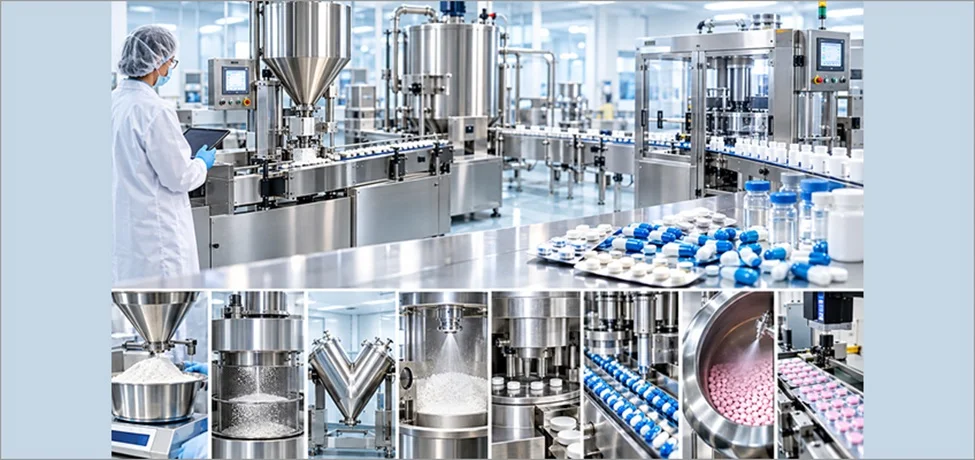
Ever wondered how a tiny tablet ends up with exactly the same dose as the billion before it? It isn't luck. It's precision engineering.
Quick answer: Pharmaceutical manufacturing equipment is the set of machines used to weigh, mix, granulate, compress, fill, coat, and package medicines. Each machine has a specific application in drug preparation, controlling one stage of the process so every dose is safe, consistent, and GMP compliant.
This guide covers the equipment used at each stage of drug preparation, what each machine is applied for, and how to choose the right setup for your facility.
In this article:
- What is pharmaceutical manufacturing equipment?
- The pharmaceutical manufacturing process, step by step
- Key equipment and its applications in drug preparation
- Tablet press and capsule filling machines in detail
- Process development in the pharmaceutical industry
- How to choose the right machinery
- FAQs
What Is Pharmaceutical Manufacturing Equipment?
Pharmaceutical manufacturing equipment refers to all the machines, vessels, and systems used to turn raw materials (active ingredients and excipients) into finished dosage forms like tablets, capsules, syrups, injectables, and creams.
You'll also hear it called pharmaceutical machinery, drug manufacturing equipment, or pharma production machinery. The names change, but the job is the same: accuracy, hygiene, and repeatability at scale.
What sets this equipment apart from ordinary industrial machinery is compliance. It has to be built from non-reactive materials (usually 316L stainless steel), be easy to clean and validate, and meet cGMP and regulatory expectations from bodies like the FDA, EMA, and CDSCO.
The Pharmaceutical Manufacturing Process: Step by Step
The pharmaceutical manufacturing process varies by dosage form, but a solid oral dose (the most common type) follows this path:
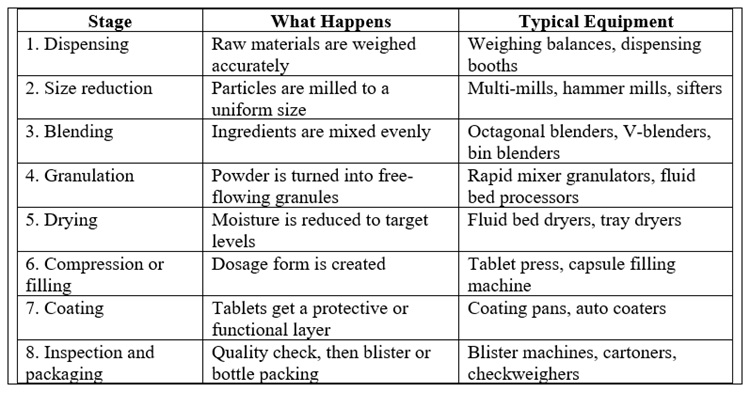
Think of it as a relay race. Each machine hands a controlled, tested product to the next.
Pharmaceutical Processing Equipment and Its Applications in Drug Preparation
1. Dispensing and weighing equipment
Application: accurate measurement of active ingredients and excipients.
Everything starts with accuracy. Even a small weighing error affects potency. Modern dispensing booths use laminar airflow to protect both the operator and the material, and many link electronically to batch records.
2. Milling and sifting machines
Application: particle size control.
Particle size affects how a drug dissolves and is absorbed by the body. Multi-mills and vibro sifters make sure powders are uniform before they move on. Skip this step and you'll see inconsistent blends and weight variation later.
3. Blenders and mixers
Application: uniform distribution of the drug throughout the formula.
Blenders combine the active ingredient with excipients like binders, fillers, and lubricants. Octagonal and bin blenders are popular because they mix gently without breaking particles down and clean easily between batches.
4. Granulators
Application: improving flow and compressibility of powders.
Fine powders flow poorly, so they're often granulated first.
- Wet granulation: rapid mixer granulators (RMG) combine powder with a liquid binder.
- Dry granulation: roller compactors press powder into sheets, then mill them, which suits moisture-sensitive drugs.
5. Fluid bed dryers and processors
Application: controlled moisture removal.
After wet granulation, granules must be dried to the right moisture level. Fluid bed dryers suspend granules in warm air for fast, even drying. Some models also handle granulation and coating.
6. Coating machines
Application: taste masking, protection, and controlled release.
Coating hides taste, protects the drug from moisture, or controls where and when it releases in the body. Perforated auto-coaters give an even film with precise spray and temperature control.
7. Liquid and sterile manufacturing equipment
Application: producing syrups, suspensions, and injectables.
These need their own systems: mixing tanks, homogenizers, filtration units, filling lines, autoclaves, and lyophilizers (freeze dryers). Sterile equipment is designed to control particles and microbes at every step.
8. Packaging and inspection machinery
Application: product protection, traceability, and final quality checks.
Blister packers, bottle fillers, labelers, and cartoners protect the product and provide traceability. Checkweighers and vision inspection systems catch defects before anything leaves the plant.
Drug Automatic Capsule and Tablet Press Machines: The Heart of Solid Dosage Production
If one machine defines oral drug production, it's the drug automatic capsule and tablet press machine. These two machines make most of the world's oral medicines.
How a tablet press works
A tablet press compresses granulated powder between an upper and lower punch inside a die. Each cycle has four moves:
1. Filling: the die fills with a measured amount of granules
2. Metering: excess powder is leveled off
3. Compression: punches apply force to form the tablet
4. Ejection: the finished tablet is pushed out
A rotary tablet press does this across dozens of stations at once, producing hundreds of thousands of tablets an hour. Modern presses monitor compression force, weight, and thickness in real time and automatically reject tablets that fall outside limits.
How an automatic capsule filling machine works
Automatic capsule fillers separate the capsule halves, fill the bottom with powder, pellets, or granules, then rejoin and lock them. Dosing is done by tamping pins or dosator systems, depending on the powder's flow properties. Many machines also weigh each capsule and reject any that miss the target.
Why automation matters here
- Consistency: every tablet or capsule matches the specification
- Speed: output can reach hundreds of thousands of units per hour
- Compliance: automated data capture supports audit trails and data integrity
- Lower contamination risk: less human handling means fewer errors
Process Development in the Pharmaceutical Industry
Buying good machines is only half the story. Process development in the pharmaceutical industry is how a lab-scale formula becomes a reliable commercial process.
It typically moves through these phases:
1. Formulation development: choosing the right ingredients and dosage form
2. Lab and pilot scale trials: testing on small batches with scaled-down equipment
3. Scale-up: adjusting parameters such as mixing time, compression force, and drying temperature for larger machines
4. Process validation: proving the process consistently produces quality product
5. Technology transfer: moving the finalized process to the manufacturing site
Many companies now apply Quality by Design (QbD) and Process Analytical Technology (PAT). Instead of testing quality at the end, they build and monitor it into every step, which means fewer failed batches and faster approvals.
How to Choose the Right Pharmaceutical Production Equipment
Whether you're building a new plant or upgrading an old one, check these points first:
- Regulatory compliance: does the equipment meet cGMP and support IQ/OQ/PQ validation?
- Material of construction: contact parts should be 316L stainless steel or equivalent
- Batch size and output: match capacity to real demand, not just best-case projections
- Flexibility: can the machine handle multiple products and quick changeovers?
- Cleaning ease: clean-in-place (CIP) features cut downtime and cross-contamination risk
- Automation and data: look for PLC/SCADA integration and data integrity features
- After-sales support: spare parts, training, and service response matter more than most buyers expect
- Total cost of ownership: the cheapest machine rarely stays cheapest after maintenance and downtime
A good rule of thumb: ask the supplier for validation documentation and a reference site visit before you commit.
Trends Shaping Pharmaceutical Machinery
- Continuous manufacturing: instead of separate batches, materials flow through connected machines nonstop, saving time and space
- Smart factories: sensors and AI help predict maintenance needs and spot deviations early
- Containment systems: highly potent drugs need isolators and closed transfer systems to protect operators
- Sustainability: energy-efficient dryers and less solvent use are becoming standard expectations
Frequently Asked Questions
What is the most important equipment in pharmaceutical manufacturing?
It depends on the dosage form, but for solid oral drugs, the tablet press and capsule filling machine are central, since they define the final dose.
What is the difference between pharmaceutical machinery and drug manufacturing equipment?
Nothing significant. Both terms describe the machines used to produce medicines. "Machinery" is more common in engineering and export contexts.
What materials are used to make pharmaceutical equipment?
Mostly 316L and 304 stainless steel for product-contact parts, because they resist corrosion, don't react with drugs, and clean easily.
How is pharmaceutical equipment validated?
Through Installation Qualification (IQ), Operational Qualification (OQ), and Performance Qualification (PQ), which prove the machine is installed correctly, operates as intended, and performs consistently.
What is the difference between wet and dry granulation?
Wet granulation uses a liquid binder and then drying. Dry granulation compacts powder without liquid, which suits heat- or moisture-sensitive drugs.
How many tablets can a rotary tablet press make?
Industrial rotary presses can produce anywhere from tens of thousands to several hundred thousand tablets per hour, depending on the model and tooling.
Final Thoughts
Pharmaceutical manufacturing equipment does more than move materials from A to B. It protects dose accuracy, product safety, and patient trust. From the first weighing step to the final blister pack, each machine has a specific application in drug preparation, and choosing the right ones can decide whether a plant runs smoothly or struggles with deviations.
If you're planning a new line or upgrading existing pharmaceutical processing equipment, start with your product, your batch size, and your compliance needs, then work backward to the machines.
 Media Pack Download
 Newsletters
 Industrial Events