Pharmaceutical Manufacturing Equipment: Types and Uses
Quick answer: Pharmaceutical manufacturing equipment is the set of machines used to turn raw ingredients into safe, consistent medicines. The main types are milling and granulation equipment, pharmaceutical mixing equipment, tablet presses, coating machines, capsule and liquid filling machines, sterile processing systems, and pharmaceutical packaging machines. Each supports a specific step in the pharmaceutical manufacturing process.
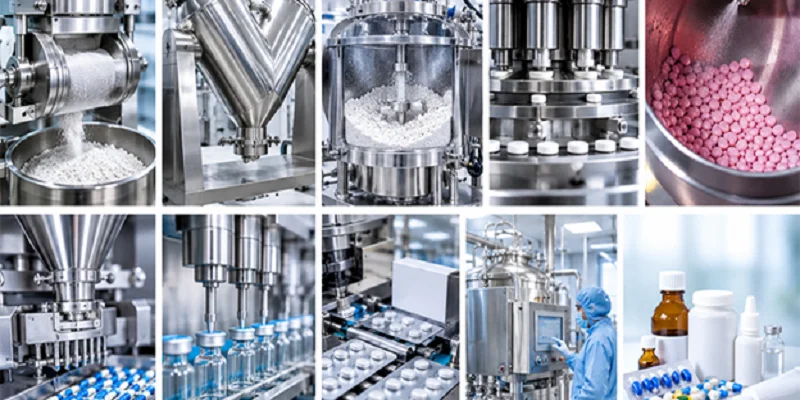
A modern pharmaceutical plant is cleaner and quieter than most people expect. What you notice next is how many machines work together to make one medicine. A tablet takes only a couple of seconds to swallow, but before it reaches the pharmacy shelf it may have passed through eight or ten different pieces of pharmaceutical machinery, including mills, blenders, granulators, tablet presses, coaters, and packaging lines.
Whether you're a student, a procurement manager, a startup founder, or just curious, this guide explains the main categories of pharmaceutical machinery, what each one does, and how to think about choosing the right setup.
What Is Pharmaceutical Manufacturing Equipment?
Pharmaceutical manufacturing equipment includes every machine, vessel, and system used to produce medicines at scale. You'll also see it called drug manufacturing equipment or pharmaceutical production equipment, and the terms are mostly interchangeable.
What sets it apart from ordinary industrial machinery is the standard it must meet. Every surface that touches a product must be easy to clean, made from non-reactive materials (usually 316L stainless steel), and built to comply with Good Manufacturing Practice (GMP) guidelines. A mistake isn't just a defective product. It can be a patient safety issue.
How Does the Pharmaceutical Manufacturing Process Work?
Before looking at individual machines, it helps to see the big picture. Most solid-dose medicines follow roughly this path:
- Raw material handling: weighing, sieving, and dispensing active ingredients and excipients
- Size reduction and blending: milling particles and mixing them evenly
- Granulation: turning powder into free-flowing granules
- Compression or filling: forming tablets or filling capsules
- Coating: adding a protective or functional layer
- Packaging: blistering, bottling, labeling, and cartoning
- Quality control: testing at every stage
Liquids, injectables, and creams follow different routes, but the logic is the same: prepare, combine, form, protect, package. Each step relies on dedicated pharmaceutical processing equipment.
Types of Pharmaceutical Manufacturing Equipment and Their Uses
1. Milling and Size Reduction Equipment
Active ingredients often arrive as coarse crystals or lumps. Mills, such as hammer mills, cone mills, and jet mills, break them down to a controlled particle size. This matters more than most people realize. Particle size affects how fast a drug dissolves and how well the body absorbs it.
2. Pharmaceutical Mixing Equipment
If the active ingredient isn't distributed evenly, one tablet might carry too much and the next too little. That's where pharmaceutical mixing equipment comes in.
- V-blenders and double-cone blenders gently tumble dry powders.
- Ribbon blenders suit larger volumes and slightly cohesive powders.
- Octagonal and bin blenders allow mixing directly in transfer containers, reducing cross-contamination.
- High-shear mixers combine powder with liquid binders, and are often paired with granulation.
- Homogenizers and planetary mixers handle creams, ointments, and suspensions.
- Content uniformity is one of the most scrutinized quality attributes in regulatory inspections, so this is a stage manufacturers take seriously.
3. Granulation Equipment
Raw powders flow poorly and tend to separate during handling. Granulation equipment solves this by binding fine particles into larger, uniform granules.
- Wet granulation uses a liquid binder. Equipment includes high-shear granulators and fluid bed granulators/dryers. It produces strong, dense granules.
- Dry granulation uses pressure, not liquid. A roller compactor presses powder into sheets, which are then milled into granules. It's ideal for moisture- or heat-sensitive drugs.
- Extrusion and spheronization equipment creates small round pellets for modified-release capsules.
Choosing between wet and dry methods usually comes down to the stability of the drug and the properties of the formulation.
4. Tablet Compression Machines
The tablet press is the heart of solid-dose manufacturing. Granules are fed into a die, compressed by upper and lower punches, and ejected as a finished tablet. Single-punch presses are used in labs and small trials, while rotary presses can produce hundreds of thousands of tablets per hour. Modern machines monitor weight, hardness, and thickness in real time.
5. Coating Equipment
Many tablets get a thin coating for taste masking, easier swallowing, protection from moisture, or controlled release. Perforated pan coaters tumble tablets while a spray gun applies the coating solution and warm air dries it. Fluid bed coaters are used for pellets and fine particles.
6. Capsule and Pharmaceutical Filling Machines
A pharmaceutical filling machine deposits a precise amount of product into its container. Types depend on the dosage form:
- Capsule filling machines (semi-automatic or fully automatic) fill hard gelatin or HPMC capsules with powder, pellets, or granules.
- Liquid filling machines use piston, peristaltic, or time-pressure pumps for syrups, solutions, and suspensions.
- Vial and ampoule filling lines operate in sterile conditions for injectables, often inside isolators or restricted-access barrier systems.
- Powder and cream/tube fillers cover dry powders and topical products.
- Accuracy is everything here. Even a small dosing error across millions of units adds up to a serious compliance problem.
7. Sterile Processing Equipment
Injectables, eye drops, and some biologics must be completely free of microbes. This area uses autoclaves, depyrogenation tunnels, lyophilizers (freeze dryers), filtration systems, and cleanroom isolators. It's the most heavily regulated and capital-intensive part of the industry.
8. Pharmaceutical Packaging Machines
Packaging does more than make a product look good. It protects it from light, moisture, and tampering for its entire shelf life. A typical pharmaceutical packaging machine line includes:
- Blister packing machines that seal tablets or capsules between formed plastic or aluminum layers
- Strip packing machines for moisture-sensitive products
- Bottle filling, capping, and induction sealing equipment
- Labeling machines with print verification
- Cartoning machines that place blisters and leaflets into boxes
- Serialization and track-and-trace systems that print and verify unique codes to fight counterfeit drugs
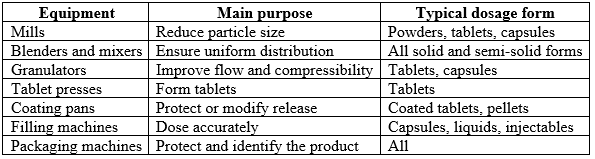
Quick Reference: Equipment at a Glance
How to Choose the Right Equipment
Buying drug manufacturing equipment is a long-term decision, and the cheapest quote is rarely the best one. Ask these questions first:
- What are you making, and at what volume? A batch-scale R&D lab and a commercial plant need very different machines.
- Is the equipment GMP-compliant? Look for proper documentation, material certificates, and validation support (IQ/OQ/PQ).
- How easy is it to clean? Fast changeovers save real money, especially if you run multiple products.
- Can it scale? Equipment that can grow with your batch sizes saves you from replacing it in three years.
- What does after-sales support look like? Spare parts, training, and service response times matter more than most buyers expect.
Trends Shaping Pharmaceutical Machinery Today
The industry is changing quickly. A few shifts worth watching:
- Continuous manufacturing, where materials flow nonstop from powder to tablet instead of in separate batches, is gaining regulatory support for its efficiency and consistency.
- Automation and AI-driven monitoring are reducing human error and enabling predictive maintenance.
- Single-use technologies are making biologics and small-batch production more flexible.
- Smaller, modular lines are helping startups and contract manufacturers enter the market without enormous capital investment.
Frequently Asked Questions
What is the most important equipment in pharmaceutical manufacturing?
There's no single answer, since each step is critical. For solid-dose drugs, the tablet press and the blender often get the most attention, because they directly affect dose accuracy and uniformity.
What is the difference between wet and dry granulation?
Wet granulation uses a liquid binder and drying, producing strong granules. Dry granulation compacts powder with pressure and no liquid, making it better for heat- or moisture-sensitive drugs.
What materials are used to make pharmaceutical equipment?
Mostly 316L and 304 stainless steel for product-contact parts, along with approved gaskets and seals made of silicone or PTFE. These resist corrosion and clean easily.
Why must pharmaceutical machinery be GMP-compliant?
GMP ensures that products are consistently made and controlled to quality standards. Non-compliant equipment can cause contamination, dosage errors, and failed inspections.
What does a pharmaceutical packaging machine do?
It seals, labels, and boxes medicines to protect them from moisture, light, and tampering, and it often prints serial numbers for traceability.
Final Thoughts
From the first milling step to the last carton, every machine in a drug plant exists for one reason: to deliver the same safe, effective dose every single time. Understanding how pharmaceutical production equipment fits together helps you make smarter buying decisions, communicate better with suppliers, and spot where efficiency gains hide.
If you're planning a new facility or upgrading an existing line, start with your product and process requirements, not the machine catalog. The right equipment follows from there.
 Media Pack Download
 Newsletters
 Industrial Events