Analytical Instrument Qualification in 2026: A Global Compliance a Practical Checklist

A practical guide to qualifying pharmaceutical analytical instruments across USP, EU, and ISO frameworks - and choosing suppliers who won't cost you an audit finding.
If you've ever sat across from an FDA or MHRA inspector while they flip through an instrument's qualification file, you already know the feeling this article is trying to prevent. A missing OQ report. A calibration certificate that doesn't map to a traceable standard. A vendor who went quiet three months after installation. None of these are dramatic failures - they're small gaps that add up to a 483 observation or, worse, a data integrity question mark on results you've already released.
2026 hasn't changed the fundamentals of analytical instrument qualification, but it has raised the bar on how consistently labs are expected to apply them across regions. Inspectors are increasingly cross-referencing USP, EU GMP Annex 15, and ISO 17025 expectations in the same audit, and labs that treat these as separate silos are the ones getting flagged. This piece lays out where the frameworks agree, where they diverge, and a checklist you can actually use - not just read.
Instrument Qualification vs Calibration: Get This Distinction Right First
This one trips up more labs than it should. Instrument qualification vs calibration isn't a semantic argument - regulators treat them as distinct, documented activities with different scopes.
Calibration confirms that an instrument's measurement output matches a known reference value within defined tolerances, at a specific point in time. It's narrow, numeric, and repeatable - think of a balance checked against certified weights.
Qualification is broader. It's the documented evidence that an instrument is correctly installed, operates as intended across its working range, and performs consistently for its intended use, in its actual environment, over time. Qualification includes calibration as one component, alongside installation checks, operational testing, and performance verification.
Rule of thumb: calibration answers "is this reading accurate right now?" Qualification answers "can I trust this instrument to generate GMP-compliant data, in this lab, for this application, reliably?"
The IQ/OQ/PQ Framework, Refreshed for 2026
Most pharmaceutical analytical instruments still move through the same four-stage lifecycle, though 2026 guidance places more weight on ongoing verification than a one-time event.
- DQ (Design Qualification): Confirming the instrument's specifications actually meet your intended analytical use before you buy it.
- IQ (Installation Qualification): Verifying the instrument arrived, was installed, and is configured according to manufacturer specs and your site requirements.
- OQ (Operational Qualification): Testing that the instrument functions correctly across its full operating range under controlled conditions.
- PQ (Performance Qualification): Demonstrating consistent, reliable performance under actual routine-use conditions, typically repeated periodically.
What's shifted is the expectation around continuous monitoring between PQ cycles - system suitability tests, trend analysis of QC data, and automated alerts when an instrument drifts. Auditors in 2026 are less interested in a qualification binder from three years ago and more interested in whether you'd catch a drifting HPLC pump before it produced an out-of-specification result.
USP <1058> vs EU Requirements for Instrument Qualification
This comparison comes up constantly for labs operating across US and European markets, so it's worth laying out plainly.
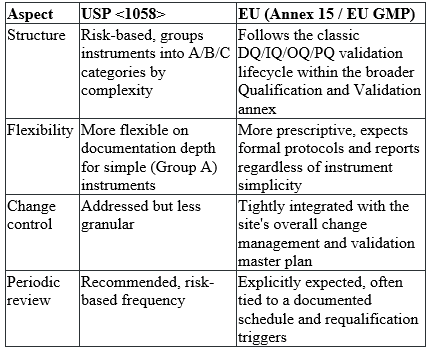
In practice, most global manufacturers qualify to the stricter EU standard and treat USP <1058> as confirmation they're covered for US submissions too. If your lab supplies both markets, build your qualification SOPs around Annex 15's rigor - it rarely creates a gap against USP, but the reverse isn't always true.
Another frequent point of confusion, especially for contract testing labs that hold both accreditations.
ISO 17025 vs GMP for Analytical Instruments
ISO 17025 is a laboratory competence standard. It focuses on the technical validity of test results - method validation, measurement uncertainty, traceability of reference standards, and staff competence. It's assessed by an accreditation body, not a health authority.
GMP is a quality system requirement enforced by regulators like the FDA, MHRA, and EMA. It covers the instrument's role within a broader quality management system - documentation control, data integrity, deviation handling, and product impact.
A lab can be ISO 17025 accredited and still fail a GMP inspection if its qualification records don't tie back to batch release decisions, or if change control isn't documented to GMP expectations. The two frameworks overlap heavily on instrument qualification mechanics but differ on intent: ISO 17025 asks "is this result technically sound?" GMP asks "can this result be trusted to release a drug product to patients?" Labs serving pharma clients generally need both lenses applied simultaneously.
How to Choose an Analytical Equipment Supplier for Pharma
Instrument qualification starts long before the equipment arrives - it starts with who you buy from. Weak analytical equipment suppliers create qualification headaches that no amount of internal SOP rigor can fully offset.
What separates a reliable supplier from a risky one
- Documentation package quality: Do they provide DQ support documents, IQ/OQ protocols, and traceable calibration certificates as standard, or as a paid afterthought?
- Regulatory track record: Ask for references from other pharma clients who've been through an FDA or MHRA inspection using their instruments.
- Post-sale support model: Response time SLAs, availability of qualified field service engineers, and spare parts lead times matter more than the initial sale price.
- Software validation support: For instruments with embedded software (chromatography data systems, spectrometers), does the vendor provide validation packages aligned with data integrity expectations?
- Global consistency: If you operate multi-site, does the vendor deliver the same qualification documentation standard in every region, or does quality vary by local distributor?
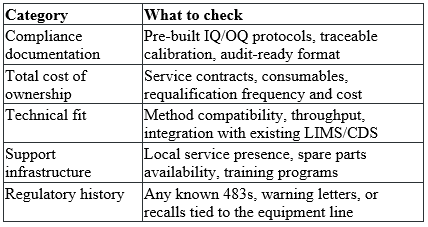
Analytical Equipment Vendor Comparison: A Simple Scoring Approach
Rather than comparing vendors on price and specs alone, score them across these five weighted categories before issuing a purchase order:
Lab Equipment Procurement: Running a Compliant RFQ Process
An analytical instrument RFQ pharma teams issue should never be a bare-bones price request. Build qualification requirements directly into the RFQ so vendors self-select based on their ability to support them.
What to include in the RFQ
- A clear user requirements specification (URS) tied to intended analytical method(s)
- A mandatory requirement for DQ support documentation and IQ/OQ protocol templates
- Calibration traceability expectations (NIST, national metrology institute, or ISO 17025-accredited provider)
- Software validation documentation for any instrument with a data system
- Warranty terms, service response SLA, and requalification support after major repairs
- Data integrity features: audit trails, user access controls, electronic signature compliance
Vendors who hesitate on any of these, or push back on documentation requests as "non-standard," are telling you something about how the relationship will go after year one.
Analytical Instrument Qualification Checklist Pharma Teams Can Use Today
- User Requirements Specification (URS) documented and approved before procurement
- Design Qualification (DQ) completed against URS and vendor specifications
- Installation Qualification (IQ) executed with documented site conditions and utilities verification
- Operational Qualification (OQ) covering full operating range, including boundary/edge-case testing
- Performance Qualification (PQ) under actual routine-use conditions, with defined acceptance criteria
- Calibration certificate traceable to a recognized national or international standard
- Software/CDS validation documentation, where applicable, including audit trail review
- SOP for periodic requalification with a defined, risk-based frequency
- Change control procedure linked to instrument qualification status
- Preventive maintenance schedule aligned with vendor recommendations
- Training records for all personnel operating the instrument
- Deviation and out-of-tolerance handling procedure specific to the instrument
Frequently Asked Questions
What's the difference between instrument qualification and calibration?
Calibration checks measurement accuracy against a known reference at a single point in time. Qualification is the broader, documented process confirming an instrument is correctly installed, operates across its full range, and performs reliably for its intended use — calibration is one part of qualification, not a substitute for it.
Is USP <1058> legally required outside the US?
No. USP <1058> is a US Pharmacopeia general chapter, not a legal mandate, though it's widely treated as best practice globally. Labs operating in the EU should align primarily with EU GMP Annex 15, which is more prescriptive.
Can an ISO 17025-accredited lab skip GMP requirements for instrument qualification?
No. ISO 17025 addresses technical competence and result validity; GMP addresses the quality system context those results sit within, including data integrity and product impact. Pharma-serving labs typically need to satisfy both simultaneously.
How often should analytical instruments be requalified?
There's no single universal interval - frequency should be risk-based, tied to instrument criticality, usage intensity, and historical performance data, then documented in a formal SOP with a defined schedule.
What should be included in an analytical instrument RFQ for pharma procurement?
Beyond price and specifications, the RFQ should require DQ support documentation, IQ/OQ protocol templates, calibration traceability details, software validation support, and clearly defined post-sale service SLAs.
The Bottom Line
Analytical instrument qualification in 2026 isn't harder than it was five years ago - it's more interconnected. Regulators expect procurement decisions, vendor documentation, and internal qualification protocols to tell one consistent, traceable story. Choosing the right analytical equipment suppliers, building compliance requirements into every RFQ, and understanding exactly where USP, EU, and ISO expectations align (and where they don't) is what turns instrument qualification from a recurring audit risk into a routine, well-oiled process.
Start with the checklist above, treat vendor selection as a compliance decision and not just a purchasing one, and periodic requalification stops being a scramble and starts being paperwork you already have ready.
 Media Pack Download
 Newsletters
 Industrial Events