Pharmaceutical Contract Manufacturing: CDMO Services, Drug Production and Outsourcing Capabilities

Pharmaceutical contract manufacturing lets drug companies outsource development, API synthesis, formulation and commercial production to specialist external partners. This article explains what CDMOs do, how outsourced manufacturing supports commercial supply, the services on offer, and a practical, step-by-step framework for selecting a reliable contract manufacturer for pharmaceutical production and scale-up.
Introduction:
Quick Answer: What Is Pharmaceutical Contract Manufacturing?
Pharmaceutical contract manufacturing is when a drug company hires a specialist organization to develop, produce, test or package its medicines instead of doing it all in-house. A CDMO (Contract Development and Manufacturing Organization) covers both development and manufacturing, from early formulation work to full-scale commercial supply.
That’s the short version. The rest of this article covers what’s behind it.
Why Do Drug Companies Outsource Manufacturing?
Imagine you’ve spent eight years and a lot of investor money getting a molecule through clinical trials. The science works. Now you need a facility that meets global GMP standards, validated equipment, trained staff, regulatory documentation and a stable supply chain. Building that can take years and a huge capital outlay, before a single patient benefits.
This is the gap that outsourced pharmaceutical production fills. Companies turn to contract manufacturers for a few common reasons:
- Speed. An existing, inspected facility can shorten the path from late-stage development to market.
- Cost control. Capital goes toward research and commercialization instead of plants and equipment.
- Expertise. Specialized technologies such as sterile injectables, highly potent compounds or complex oral solids need experience that’s hard to hire quickly.
- Flexibility. Demand rarely behaves as forecast, and a contract partner can scale volumes up or down.
- Risk sharing. Experienced partners already know the regulatory and technical pitfalls.
It’s not just small biotechs, either. Large pharma outsources too, often for capacity overflow or specialized technologies.
CDMO vs CMO vs CRO: What’s the Difference?
These acronyms get mixed up constantly, so here’s a simple breakdown.
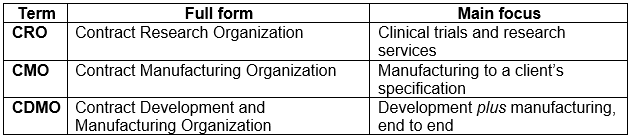
A CMO makes what you hand it. A CDMO helps you figure out how to make it, then makes it. For companies without a big internal technical team, that difference matters a great deal.
What Services Do Contract Development and Manufacturing Organizations Provide?
This is one of the most searched questions in the space, so here’s a clear answer. A full-service CDMO typically offers:
1. Drug substance (API) development and manufacturing. This covers route scouting, process development, synthesis, purification and scale-up of active pharmaceutical ingredients, including outsourced manufacturing of APIs for small molecules and, at some CDMOs, biologics.
2. Drug product (formulation) development. Scientists design the final dosage form, whether tablets, capsules, liquids, injectables, creams or inhalables. They work through stability, bioavailability and how the product behaves in real-world storage.
3. Analytical development and testing. Method development, validation, release testing and stability studies, all needed to prove a product is what it claims to be.
4. Clinical trial supply manufacturing. Small batches made to GMP standards for Phase I to III studies, often with blinding, labelling and packaging included.
5. Commercial-scale manufacturing. Validated, repeatable production at volume, which is the core of pharmaceutical CDMO services for commercial production.
6. Packaging and serialization. Primary and secondary packaging, labelling, and track-and-trace compliance for different markets.
7. Regulatory support. Help compiling dossiers, supporting inspections and managing post-approval changes.
8. Supply chain and logistics. Sourcing raw materials, managing cold-chain requirements and coordinating distribution.
Not every CDMO does everything. Some specialize deeply in one area, such as sterile fill-finish or high-potency APIs, and that specialization can be a real strength.
How Does Pharmaceutical Contract Manufacturing Support Commercial Drug Production?
Getting a drug approved is one challenge. Producing it consistently, at scale, for years, is another. Here’s how contract manufacturing supports that second phase.
Technology transfer. The process moves from the lab or pilot scale to the CDMO’s facility. This step is delicate. A reaction that behaves perfectly in a 5-litre flask can act very differently in a 5,000-litre reactor. Good partners document everything and run engineering batches before the real thing.
Process validation. Before commercial sale, manufacturers must show the process reliably produces product meeting quality specifications. Regulators expect this evidence.
Consistent quality. A mature quality management system covers batch records, deviation handling, change control and audits. When a regulator inspects, it inspects the partner too, and your product’s reputation rides on theirs.
Capacity on demand. If a product takes off, a well-resourced CDMO can add batches, lines or shifts. If demand is slower than expected, you aren’t stuck with an expensive idle plant.
Lifecycle support. After launch, there are formulation tweaks, new strengths, new markets and supply-chain changes. A long-term partner helps manage all of it.
In short, contract drug manufacturing turns a promising molecule into a dependable product on pharmacy shelves.
Outsourced Manufacturing of APIs and Drug Formulations: What to Know
APIs and finished formulations are often handled by different facilities, sometimes by different companies. Here’s how the two compare.
APIs are the active ingredients. Manufacturing them involves chemistry or biotechnology, careful control of impurities, solvent management and strict environmental and safety rules. Highly potent or cytotoxic APIs need specialized containment.
Formulations turn that API into something patients can take. This is where excipients, particle size, dissolution behaviour and shelf life come in. A tablet that dissolves too slowly, or an injectable that degrades in storage, is a failed product regardless of how pure the API was.
Some companies keep both under one roof for simplicity. Others split them to access best-in-class capabilities. Neither is wrong, but the handoffs between sites should be planned early.
How to Select a Contract Manufacturer for Pharmaceutical Production and Scale-Up
This is where a lot of projects are won or lost. A poor partner choice can cost you months, money and regulatory credibility. Here’s a practical way to approach it.
1. Start with your own requirements
Write down the basics first: molecule type, dosage form, batch sizes, target markets, timeline, and any special needs such as sterility, potency or temperature control. A vague brief gets vague proposals.
2. Check regulatory standing
Look at inspection history with relevant authorities such as the US FDA, EMA, MHRA, WHO or your target market’s regulators. Ask about recent audit outcomes and how observations were resolved. A clean record isn’t mandatory, but transparency about problems is.
3. Match technical capabilities to your product
Does the CDMO have real experience with your specific dosage form and technology? Ask for relevant case studies. Experience with your molecule class beats general claims every time.
4. Evaluate scalability
Can they handle your clinical batches and your projected commercial volumes? Switching partners mid-programme means repeating technology transfer and possibly regulatory filings, so it’s worth choosing one that can grow with you.
5. Look at quality culture, not just certificates
Visit the site if possible. Notice how clean, organised and well-documented things are. Talk to the quality team. Ask how they handle deviations and what their right-first-time batch record looks like.
6. Assess communication and project management
You’ll work with these people daily for years. Will you have a dedicated project manager? How fast do they respond? Are timelines realistic or just optimistic to win the deal? Slow, unclear communication early on rarely improves later.
7. Understand pricing and contract terms
Compare more than the headline price. Look at minimum order quantities, change-order costs, raw material pass-through, exclusivity clauses, intellectual property ownership and exit terms. Cheapest quotes sometimes hide expensive surprises.
8. Consider supply chain resilience
Where do their raw materials come from? Do they have backup suppliers? Recent years showed how fragile global supply chains can be, and a partner with a robust plan protects your launch.
9. Protect your intellectual property
Make sure confidentiality, data integrity and IP ownership are clearly defined in writing before sharing proprietary processes.
10. Run a pilot or audit before committing
If you can, start with a smaller project or conduct a formal quality audit. It’s much cheaper to discover a mismatch early.
Common Mistakes to Avoid
- Choosing on price alone. The lowest bid often costs more once delays and rework pile up.
- Treating the CDMO as a vendor, not a partner. Share information openly. Problems surface faster that way.
- Skipping technology-transfer planning. Rushed transfers are a leading cause of delays.
- Ignoring regulatory alignment. Make sure the facility is approved for your target markets before signing.
- Over-relying on a single supplier. Where possible, qualify a backup.
Trends Shaping the CDMO Landscape
The industry keeps evolving. Some themes worth watching: growing demand for biologics, cell and gene therapy manufacturing, continuous manufacturing technologies, increased digitalization of batch records and quality systems, and a stronger push for regional supply-chain diversification. Sustainability, from solvent reduction to greener chemistry, is also moving from a nice-to-have into a selection criterion. Partners investing in these areas are generally planning for the long term.
Frequently Asked Questions
What is a CDMO in the pharmaceutical industry?
A CDMO is a company that provides both drug development and manufacturing services to pharmaceutical and biotech firms, from early formulation to commercial production.
Is contract manufacturing safe and compliant?
Yes, when the partner operates under Good Manufacturing Practice (GMP) and is regularly inspected by regulators. Responsibility for product quality is shared, so oversight and audits remain essential.
How long does a technology transfer take?
It varies widely with product complexity, from a few months for simple oral solids to a year or more for complex sterile or biologic products.
Can small biotech companies use CDMOs?
Absolutely. Outsourcing is especially valuable for smaller companies without manufacturing infrastructure.
What does it cost to outsource drug manufacturing?
Costs depend on dosage form, batch size, complexity, testing needs and regulatory requirements. Request detailed, itemized quotes from multiple providers.
How do I choose between multiple CDMOs?
Compare regulatory history, technical fit, scalability, quality culture, communication, supply-chain resilience and total cost, not just price.
Final Thoughts
Pharmaceutical contract manufacturing isn’t just a cost-saving tactic anymore. For many companies, it’s the smartest route to getting good medicines to patients faster and more reliably. The best CDMO relationships feel less like a transaction and more like an extension of your own team.
If you’re evaluating partners, take your time, ask uncomfortable questions and visit the site. The right fit pays off for the life of your product.
 Media Pack Download
 Newsletters
 Industrial Events