Pharmaceutical Laboratory Instruments: Types and Uses
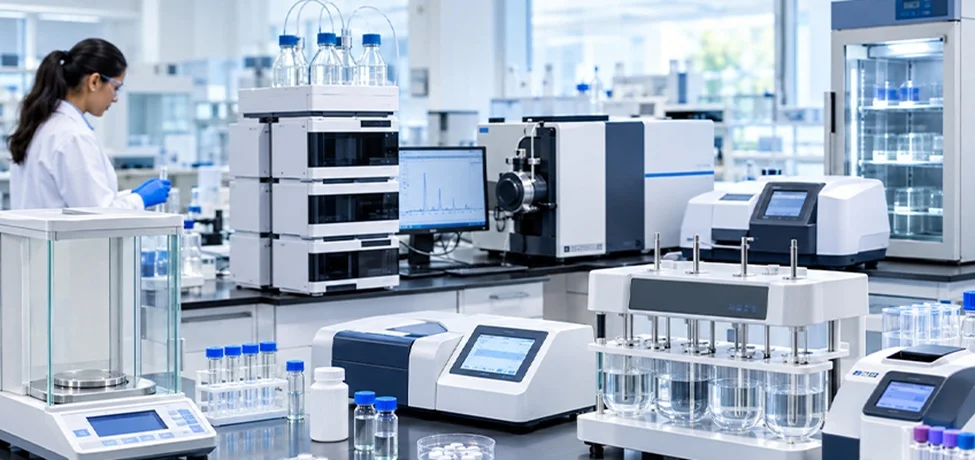
Every tablet you swallow has passed through a lab first. Before it reaches a pharmacy shelf, someone has checked its strength, purity, dissolution, and shelf life, and they did it with instruments that measure to fractions of a milligram.
If you’re setting up a lab, upgrading one, or just learning how drug quality is verified, this guide walks through the main pharmaceutical laboratory instruments, what each one does, and what to look for when you buy.
Quick answer: Pharmaceutical laboratory instruments are the devices used to test the identity, purity, potency, and stability of drugs. The most common are HPLC systems, gas chromatographs, UV-Vis and FTIR spectrophotometers, dissolution testers, analytical balances, and mass spectrometers.
What Is Pharmaceutical Quality Control, and Why Do Instruments Matter?
Pharmaceutical quality control (QC) is the set of tests that confirm a drug meets its approved specifications before it is released. It covers raw materials, in-process samples, finished products, and stability samples.
Instruments matter because the human senses can’t tell whether a tablet holds 498 mg or 502 mg of active ingredient. Regulators such as the USFDA, EMA, and CDSCO, and pharmacopoeias such as the USP, Ph. Eur., and Indian Pharmacopoeia, expect data from calibrated, qualified equipment. If the instrument can’t be trusted, neither can the result.
A well-run quality control laboratory therefore does two jobs at once. It tests the product, and it proves that the testing itself is reliable.
What Are the Main Types of Analytical Instruments in a Pharma Lab?
Most analytical instruments fall into five groups. Here is each one in plain language.
1. Chromatography systems (separation)
HPLC (High-Performance Liquid Chromatography) is the workhorse of almost every QC lab. It separates the components of a sample and measures each one. Labs use it for assay (how much drug is present), impurity profiling, and related-substance testing.
Gas Chromatography (GC) handles volatile compounds. Its most common job in pharma is residual solvent testing, which checks that no harmful solvents from manufacturing are left in the product.
UPLC is a faster, higher-pressure cousin of HPLC. It cuts run times and solvent use, which adds up when a lab runs hundreds of samples a week.
2. Spectroscopy instruments (identification and quantification)
UV-Visible spectrophotometers measure how much light a sample absorbs. They’re quick and economical for assays and dissolution sample analysis.
FTIR spectrometers produce a molecular “fingerprint,” which makes them ideal for confirming the identity of raw materials on arrival.
Atomic absorption (AAS) and ICP-MS detect trace metals, which matters for elemental impurity limits.
3. Mass spectrometry (high-sensitivity detection)
Mass spectrometry identifies molecules by measuring their mass-to-charge ratio. Paired with liquid chromatography (LC-MS), it can detect and characterize impurities at extremely low levels.
Labs use it for:
- Identifying unknown impurities and degradation products
- Confirming molecular weight of new compounds
- Checking for nitrosamine impurities, a major regulatory focus in recent years
- Bioanalytical work, such as measuring drug levels in plasma
It costs more than most instruments, so smaller QC labs often send specialised work to partner labs and keep HPLC and spectroscopy in-house.
4. Physical testing equipment (how the dosage form behaves)
This is where pharmaceutical testing equipment gets practical:
- Dissolution testers check how fast a tablet or capsule releases its drug
- Disintegration testers measure how quickly a tablet breaks apart
- Hardness and friability testers confirm tablets survive packaging and transport
- Particle size analyzers affect how a drug dissolves and absorbs
- Melting point apparatus and polarimeters verify material identity and purity
5. Basic and support equipment
Never underestimate the humble stuff. Analytical balances, pH meters, Karl Fischer titrators (for moisture), ovens, stability chambers, sonicators, and water purification systems feed every other test. A drifting balance or contaminated water ruins results before the sample ever reaches the HPLC.
Instrument-by-Instrument Cheat Sheet
|
Instrument |
Main use in pharma |
Typical test |
|
HPLC / UPLC |
Separate and quantify compounds |
Assay, impurities |
|
Gas chromatograph |
Analyse volatile compounds |
Residual solvents |
|
UV-Vis spectrophotometer |
Measure light absorption |
Assay, dissolution samples |
|
FTIR |
Molecular fingerprinting |
Raw material identity |
|
Mass spectrometer |
Ultra-sensitive detection |
Unknown impurities, bioanalysis |
|
Dissolution tester |
Drug release rate |
Tablet/capsule release profile |
|
Karl Fischer titrator |
Water content |
Moisture in APIs |
|
Analytical balance |
Precise weighing |
Every sample preparation |
|
Stability chamber |
Controlled temperature/humidity |
Shelf-life studies |
What Does a QC Lab Actually Need? (Start Here)
People often ask which QC lab instruments are essential for a new setup. A practical starter list for a small formulation or generic QC lab:
1. Analytical balance (and a calibrated weight set)
2. pH meter and conductivity meter
3. UV-Vis spectrophotometer
4. HPLC with a PDA/UV detector
5. Dissolution tester and disintegration tester
6. Karl Fischer titrator
7. Hardness and friability testers
8. Stability chamber
9. Purified water system
Add GC, FTIR, and mass spectrometry as your product range and regulatory demands grow. Buying everything at once is the most common and most expensive mistake.
How Do You Choose the Right Laboratory Equipment Suppliers?
The instrument is only half the purchase. The other half is the company behind it. Whether you work with laboratory equipment suppliers or specialist analytical instrument suppliers, check these points:
- Compliance support. Can they provide IQ/OQ/PQ documentation (installation, operational, and performance qualification)? Is the software 21 CFR Part 11 compliant, with audit trails and user access controls?
- Calibration and service. Ask where service engineers are based, how fast they respond, and whether spare parts are stocked locally. Downtime in a QC lab delays batch release, and delayed batches cost money.
- Application support. A good supplier helps you develop and transfer methods, not just ship a box.
Total cost of ownership. Columns, lamps, seals, consumables, software licences, and annual maintenance contracts often exceed the purchase price over the instrument’s life. Request a five-year cost estimate.
References. Ask for names of similar labs using the same model. Then call them.
Training. Poorly trained analysts generate poor data on excellent machines.
Common Mistakes Labs Make with Lab Equipment
Skipping calibration schedules. Auditors notice, and so do your results.
Buying for the dream, not the workload. A mass spectrometer sitting idle is expensive furniture.
Ignoring data integrity. Shared logins and unsecured data files are among the most frequent audit findings.
Choosing on price alone. The cheapest quote can become the costliest once downtime and consumables are counted.
Forgetting the environment. Vibration, humidity, and unstable power all affect sensitive instruments. Plan the room before the purchase.
Frequently Asked Questions
What is the most commonly used instrument in a pharmaceutical QC lab?
HPLC. It’s used for assay, impurity, and stability testing across nearly every dosage form.
What is mass spectrometry used for in pharma?
It identifies and measures compounds by their mass, especially at trace levels. Typical uses include impurity identification, degradation studies, and bioanalysis.
What is the difference between HPLC and GC?
HPLC analyses compounds dissolved in liquid and suits most drug substances. GC analyses compounds that can be vaporized without breaking down, such as residual solvents.
What does IQ/OQ/PQ mean?
Installation, Operational, and Performance Qualification: three documented steps proving an instrument is installed correctly, works as designed, and performs reliably for its intended use.
How often should lab instruments be calibrated?
It depends on the instrument, usage, and your SOPs. Balances are checked daily and calibrated regularly, while HPLC systems follow scheduled performance checks. Follow the manufacturer’s guidance and your regulatory requirements.
Can a small lab start without mass spectrometry?
Yes. Most routine QC testing relies on HPLC, UV-Vis, dissolution, and physical testers. Mass spectrometry is added when specialised impurity or bioanalytical work demands it.
Final Thoughts
The right pharmaceutical laboratory instruments protect patients, keep regulators satisfied, and make your lab faster and more confident in its own numbers. Start with the essentials, qualify everything properly, and choose suppliers who stand behind their equipment after the invoice is paid.
Planning a lab setup or an upgrade? Make a list of your products, your tests, and your sample volumes first. That one page will make every supplier conversation sharper.
 Media Pack Download
 Newsletters
 Industrial Events