Pharmaceutical Raw Materials and Components: A Guide
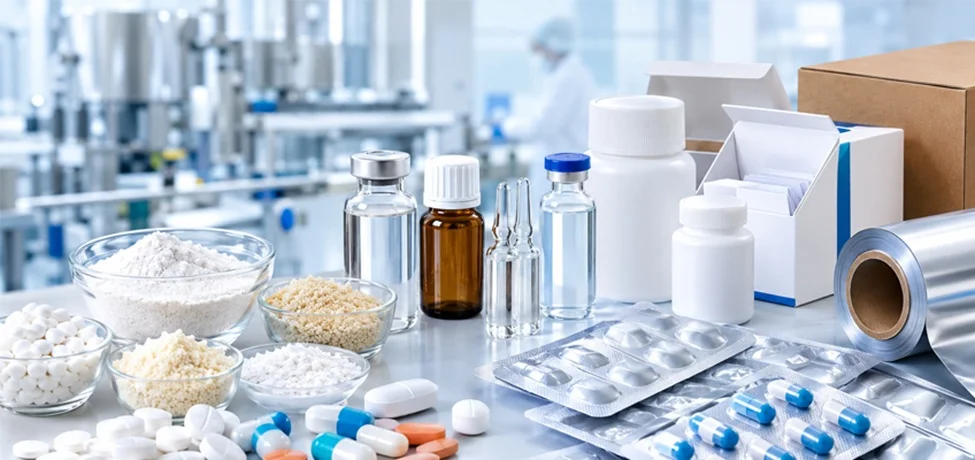
Ever wondered what's actually inside a tablet besides the medicine itself? Every capsule, syrup and injection is built from a carefully chosen mix of pharmaceutical raw materials and packaging components, from the active ingredient that treats the condition to the foil that keeps it stable on the shelf. Get just one of them wrong and an entire batch can fail. This guide explains each material in plain language: what it is, what it does, and what to check before you source it.
This guide walks through pharmaceutical raw materials and components in plain language: what they are, how they differ, and what to look for when you're sourcing or studying them.
Key Takeaways (Quick Answers)
- Pharmaceutical raw materials are all the substances used to make a drug product, including the active ingredient, excipients and processing aids.
- APIs create the therapeutic effect. Excipients deliver, stabilise and shape it.
- Pharmaceutical packaging materials protect the product from light, moisture, oxygen and contamination until it reaches the patient.
- Quality of every material, not just the API, decides product safety and shelf life.
What Are Pharmaceutical Raw Materials?
Pharmaceutical raw materials are the starting substances and inputs used to manufacture a medicine. That covers the active ingredient, the inactive ingredients, solvents, processing aids, and, in a broader sense, the packaging components that hold the finished product.
People often use "pharmaceutical materials" as an umbrella term. In practice, it helps to split them into two groups:
1. Formulation materials: what goes inside the dosage form (API, excipients, solvents).
2. Packaging materials: what goes around it (blister foil, bottles, vials, labels, cartons).
Together, these are the drug manufacturing components that every regulated facility has to source, test and track.
Why Do Raw Materials Matter So Much?
Because a medicine is only as reliable as its weakest input. A perfect API combined with a poor-quality excipient can give you a tablet that crumbles, dissolves too slowly, or degrades before its expiry date.
Regulators such as the US FDA, EMA and India's CDSCO expect manufacturers to follow Good Manufacturing Practice (GMP). That means every raw material needs a specification, a qualified supplier, identity testing, and documentation. Skipping any of this is how recalls happen.
What Are the Raw Materials in the Pharmaceutical Industry? (The Main Categories)
|
Category |
What it does |
Common examples |
|
Active Pharmaceutical Ingredient (API) |
Produces the therapeutic effect |
Paracetamol, metformin, amoxicillin |
|
Excipients |
Give shape, stability, taste, release profile |
Lactose, microcrystalline cellulose, magnesium stearate |
|
Solvents and processing aids |
Help in manufacturing; mostly removed later |
Purified water, ethanol, isopropyl alcohol |
|
Primary packaging |
Direct contact with the product |
Blister foil, glass vials, HDPE bottles |
|
Secondary packaging |
Outer protection and information |
Cartons, leaflets, labels |
Active Pharmaceutical Ingredients (API): The Heart of the Medicine
An Active Pharmaceutical Ingredient (API) is the biologically active component of a drug, the part that actually treats the condition.
In a 500 mg paracetamol tablet, the paracetamol is the API. Everything else in the tablet is there to support it.
APIs can come from different routes:
- Chemical synthesis: the most common route for small-molecule drugs.
- Fermentation: used for many antibiotics.
- Plant or animal extraction: for certain natural-origin drugs.
- Biotechnology: for biologics such as insulin and monoclonal antibodies.
What to check when sourcing APIs: purity and impurity profile, particle size, polymorphic form, a valid Drug Master File (DMF) or CEP, and consistent batch-to-batch quality. India is one of the world's largest API and generic-medicine producers, so supplier choice here is a real strategic decision, not a formality.
Pharmaceutical Excipients: The Unsung Heroes
Excipients are the inactive ingredients added to a drug formulation to help manufacture, stabilize, protect or deliver the API. "Inactive" doesn't mean unimportant. Many tablets are 70 to 90 percent excipient by weight.
Here are the main types and what they do:
- Binders (povidone, starch) hold the tablet together.
- Fillers or diluents (lactose, mannitol) add bulk so a tiny API dose becomes a tablet you can handle.
- Disintegrants (croscarmellose sodium) help the tablet break apart in the stomach.
- Lubricants (magnesium stearate) stop powder sticking to machinery.
- Glidants (colloidal silica) improve powder flow.
- Coating agents protect, mask taste or control where the drug releases.
- Preservatives, colorants and sweeteners make liquids safe, recognisable and palatable.
A small change in an excipient grade can change how fast a drug dissolves. That's why formulators treat excipient selection as seriously as API selection.
Types of Pharmaceutical Packaging Materials
Now for the "components" side. Pharmaceutical packaging materials protect the medicine from light, moisture, oxygen, microbes and physical damage, and they carry the information patients and pharmacists need.
Primary packaging (touches the drug)
- Blister packs: a formed cavity (usually PVC, PVDC or Aluminium cold-form) sealed with lidding foil. Very common for tablets and capsules.
- Glass vials and ampoules: used for injectables. Type I borosilicate glass is the standard for sensitive products.
- Plastic bottles: HDPE and PET for tablets, capsules and syrups.
- Strip packs and sachets: useful for moisture-sensitive or single-dose products.
- Pre-filled syringes, cartridges and tubes: for injectables, creams and ointments.
Secondary and tertiary packaging
- Cartons, leaflets and labels carry batch number, expiry date, dosage instructions and warnings.
- Shippers and pallets protect product through distribution.
Blister Foil and Packaging Materials: A Closer Look
Blister packaging deserves its own section, because it's one of the most searched and most misunderstood areas.
What is blister foil? It's the thin aluminium layer (often called lidding foil) that seals the cavity of a blister pack. You press the tablet, and it pushes through the foil.
Typical structure:
- Aluminium layer: the barrier against moisture, oxygen and light.
- Heat-seal lacquer: bonds the foil to the plastic or aluminium base.
- Printed layer or primer: carries branding, batch details and colour coding.
Cold-form (Alu-Alu) vs thermoform (PVC/PVDC) blisters:

If your product is hygroscopic or light-sensitive, Alu-Alu is usually the safer choice. For stable products, PVC/PVDC keeps costs down.
How Are Raw Materials Controlled and Tested?
A typical quality pathway looks like this:
1. Supplier qualification: audits, questionnaires, and approved vendor lists.
2. Incoming inspection: sampling, identity tests (such as IR spectroscopy), and checks against pharmacopoeial standards (IP, USP, BP, Ph. Eur.).
3. Quarantine and release: materials stay on hold until QC approves them.
4. Storage control: correct temperature, humidity and traceability.
5. Documentation: Certificates of Analysis (CoA), batch records and change control.
This is the unglamorous work that keeps medicines safe, and it's the part regulators look at first during inspections.
Common Mistakes When Sourcing Pharma Material Components
- Choosing the cheapest supplier without checking regulatory history.
- Ignoring excipient variability between batches.
- Over-specifying packaging (wasted cost) or under-specifying it (failed stability studies).
- Skipping compatibility testing between the drug and its container.
- Poor documentation, which turns a small deviation into a big audit finding.
Frequently Asked Questions
What are pharmaceutical raw materials?
They are the substances used to make a medicine, including APIs, excipients, solvents and processing aids. Packaging materials are often grouped in as essential components.
What is the difference between API and excipient?
The API is the active ingredient that treats the condition. Excipients are inactive ingredients that help shape, stabilise, protect or deliver the API.
What are the main types of pharmaceutical packaging materials?
Glass, plastic, aluminium foil, paper and board. They are used in forms such as blisters, vials, bottles, sachets, cartons and labels.
Why is aluminium used in blister packs?
Aluminium blocks moisture, oxygen and light almost completely, which protects drugs and extends shelf life.
Who regulates pharmaceutical raw materials?
Regulators like the US FDA, EMA and CDSCO (India), working with pharmacopoeias such as IP, USP, BP and Ph. Eur.
Final Thoughts
Pharmaceutical raw materials and components aren't just a purchasing list. They're the foundation of every safe, effective medicine. Understanding how the API, excipients and packaging work together helps manufacturers, students and buyers make smarter decisions, and it helps patients trust what they're taking.
If you're building or refining your supply chain, start with the basics: know every material, know every supplier, and document everything.
 Media Pack Download
 Newsletters
 Industrial Events