Pharmaceutical Tableting and Encapsulation: Manufacturing Technologies, Equipment and Production Processes
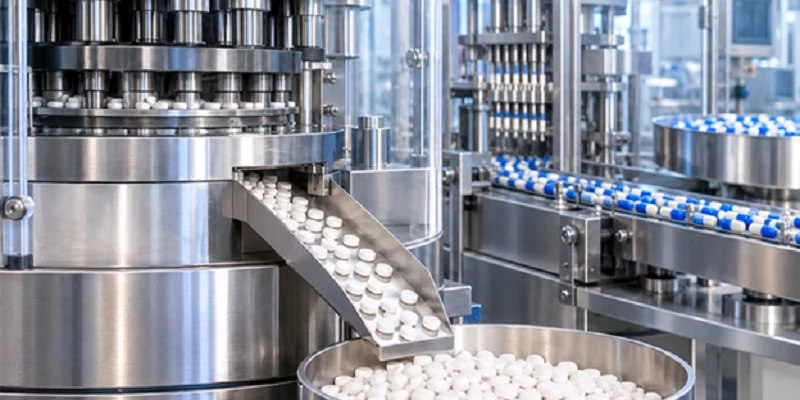
Tablets and capsules are the most widely used oral dosage forms in the pharmaceutical industry, and they account for the majority of oral medicines produced worldwide. Their manufacture involves a series of carefully controlled stages, from powder blending and granulation to tablet compression, coating and capsule filling.
This article explains how loose powders are converted into accurately dosed, stable solid dosage forms. It covers the machinery, production methods and technical considerations involved in pharmaceutical tableting equipment and capsule filling equipment, including the technologies used for compression, coating and encapsulation.
What Equipment Is Used in Pharmaceutical Tablet Manufacturing?
Pharmaceutical tablet manufacturing relies on a connected line of machines: a mill or sifter for particle size control, a blender for mixing the active ingredient with excipients, a granulator for wet or dry granulation, a tablet compression machine, a deduster, a coating system, and inspection equipment such as checkweighers and metal detectors.
Each unit addresses a specific manufacturing challenge. Most powders do not flow or compress well on their own, so much of the equipment upstream of the press exists to improve the blend's uniformity and flow. The press forms the tablet, and downstream equipment protects, finishes and verifies it.
A typical tablet manufacturing machinery line includes:
- Milling and sifting: reduces particle size and removes lumps to ensure a uniform mix.
- Blending: V-blenders, bin blenders or ribbon blenders combine the drug with fillers, binders, disintegrants and lubricants.
- Granulation: high-shear mixers and fluid bed granulators for wet granulation, or roller compactors for dry granulation.
- Compression: single-punch or rotary presses shape the final tablet.
- Coating: perforated pan coaters or fluid bed systems apply a protective or functional film.
- Inspection and packaging: checkweighers, tablet testers, and blister or bottle packing lines.
The Role of Granulation Before Compression
The quality of a tablet is largely determined before the powder reaches the press. Poorly flowing powder fills the die cavities unevenly, which leads to weight variation and, in turn, inconsistent dosing.
Granulation addresses this by agglomerating fine particles into larger, more free-flowing granules. In wet granulation, a liquid binder bonds the particles together, and the resulting granules are then dried. In dry granulation, a roller compactor presses the powder into ribbons, which are milled into granules. This method suits moisture-sensitive or heat-sensitive drugs.
Direct compression omits granulation entirely. It is suitable when the blend already has good flow and compressibility, and it offers shorter processing time and lower cost, but it demands more from the formulation.
How Tablet Compression Works in Drug Production
Tablet compression converts a powder blend into a solid tablet by applying force between two punches inside a die. The cycle consists of four stages:
- Die filling: a feeder delivers the powder into the die cavity.
- Metering: the lower punch sets the fill depth, which determines tablet weight.
- Compression: the upper and lower punches compress the powder, often in two steps. A light pre-compression removes trapped air, and the main compression establishes hardness.
- Ejection: the lower punch rises and pushes the tablet out of the die onto a take-off bar.
The full cycle takes only a fraction of a second. On a modern rotary press, dozens of punch and die stations move around a turret, allowing output of hundreds of thousands of tablets per hour.
Tablet Compression Machines: Single-Punch and Rotary Presses
Two main categories of tablet compression machines serve different production needs.
Single-punch (eccentric) presses have one die and one pair of punches. Their output is low, but they are well suited to early formulation development, where only small quantities of material are available, and to laboratory use and training.
Rotary presses form the backbone of commercial tablet compression technology for drug manufacturing. Multiple stations pass continuously through the fill, compression and ejection zones. Modern units use force-feedback systems that automatically adjust fill depth when tablet weight drifts. Double-sided designs produce two tablets per station per rotation to increase throughput.
Specialty presses are also available, including bilayer and tri-layer machines for tablets that combine different drug layers, and compression-coating presses that surround a core tablet with an outer shell.
Common Compression Defects
Several defects are associated with the compression stage. Capping, where the top of a tablet separates, and lamination, where it splits into layers, usually result from trapped air or excessive compression force. Sticking and picking occur when material adheres to the punch faces, typically because of moisture or inadequate lubrication. Weight variation may indicate poor powder flow or worn tooling.
For this reason, in-process monitoring is standard practice. Compression force sensors, tooling inspection, and routine hardness, thickness and friability testing help identify issues before they affect an entire batch.
Technologies Used for Tablet Coating
Coating serves several purposes. It can mask unpleasant taste, protect the drug from moisture and light, ease swallowing, control where the drug is released in the body, and provide product identification through color.
Pan coating is the conventional method. Tablets tumble in a rotating perforated drum while spray guns apply a coating liquid and warm air dries each layer. Modern perforated pan coaters allow precise control of airflow, temperature and spray rate, producing smooth, uniform films.
Fluid bed coating suspends small particles, pellets or minitablets in an upward air stream while coating is sprayed onto them. It is commonly used for multiparticulate and modified-release products.
Most current coatings are film coatings: thin polymer layers, often cellulose-based, applied from aqueous or solvent-based solutions. Aqueous systems are generally preferred for safety and environmental reasons. Enteric coatings resist stomach acid and dissolve in the intestine, protecting acid-sensitive drugs or reducing gastric irritation. Sugar coating is still used in some products but has declined because of its longer processing time and added bulk.
How Capsule Filling Works in Drug Production
Where tablet manufacturing depends on compression, capsule manufacturing depends on accurate dose delivery. A capsule filling machine places powder, granules, pellets or liquid into the body of a hard capsule and then joins it with the cap.
The process follows a defined sequence:
- Orientation and separation: empty capsules are fed into the machine, aligned with the cap facing up, and separated into caps and bodies.
- Filling: the dose is delivered into the capsule body using a dosing mechanism.
- Rejection and closing: improperly opened capsules are rejected, and the cap is pressed back onto the filled body and locked.
- Ejection: finished capsules are discharged for inspection and polishing.
Dosing Methods in Pharmaceutical Capsule Filling Machines
The dosing mechanism is the central feature of any pharmaceutical capsule filling machine. Common systems include:
- Dosator (tamping) systems, which use a hollow tube that enters a powder bed, forms a compressed plug and deposits it into the capsule. They are flexible and suited to high speeds.
- Tamping-pin (dosing disc) systems, which fill the holes of a disc with powder and tamp it in stages before transferring the plug to the capsule body.
- Auger fillers, which use a rotating screw to meter powder and are often used on semi-automatic machines and with cohesive powders.
- Pellet and liquid filling stations, which allow combination products, such as pellets with powder, or sealed liquid-fill formulations.
Machines are available in manual, semi-automatic and fully automatic configurations. Small laboratory and compounding setups produce a few hundred capsules per cycle, while high-speed automatic lines can produce hundreds of thousands per hour.
Hard Capsules and Softgels
Hard capsules, made from gelatin or plant-based materials such as HPMC, are filled using the methods described above. Softgels are manufactured differently. A rotary die process forms, fills and seals the capsule in a single continuous operation, which makes the format suitable for oils and poorly soluble drugs. Because softgels require dedicated equipment, many facilities specialize in either hard capsules or softgels rather than both.
Choosing Between Tablets and Capsules
The choice of dosage form depends on the properties of the drug and the needs of the patient. Tablets are cost-effective and durable at high volumes, and they can be scored for split dosing. Capsules can mask unpleasant tastes, accommodate difficult or low-dose powders, and may reduce development time because they often need less compression optimization.
Stability, bioavailability, cost, target market and regional preference also influence the decision, which is why the same active ingredient is frequently available in both forms.
Quality Control and Regulatory Compliance
Tableting equipment for solid dosage production and capsule machinery must comply with Good Manufacturing Practice (GMP) requirements. This includes validated equipment, documented procedures and controlled production environments.
Standard quality checks include content uniformity, weight variation, hardness, friability, disintegration and dissolution. Inline tools such as near-infrared sensors, metal detectors and vision systems provide additional protection. Cleaning and changeover procedures are equally important, as preventing cross-contamination between products is a key regulatory concern.
Emerging Trends in Solid Dosage Manufacturing
Several developments are shaping the future of tablet and capsule production:
- Continuous manufacturing, in which blending, granulation and compression occur in one uninterrupted line rather than in separate batches.
- Process Analytical Technology (PAT), which uses real-time sensors to monitor product quality during production.
- Smart presses and Industry 4.0 integration, including automated adjustments, predictive maintenance and electronic batch records.
- Containment and flexibility, as highly potent compounds and smaller, more personalized batches call for closed systems and faster changeovers.
Frequently Asked Questions
What is the difference between a tablet press and a capsule filling machine?
A tablet press compresses powder into a solid shape using punches and dies. A capsule filling machine measures a dose into a pre-made empty capsule shell and closes it.
Which process offers higher output?
High-speed rotary tablet presses typically achieve very high output, and modern automatic capsule fillers are also capable of high speeds. Actual output depends on the formulation and the machine configuration.
Do all tablets require coating?
No. Coating is applied only when taste masking, protection, appearance or controlled release is required.
Can a single machine produce different tablet sizes?
Yes, by changing the tooling, which consists of punches and dies. Capsule fillers similarly use change parts to accommodate different capsule sizes.
Conclusion
Tablet and capsule manufacturing combine several engineered stages: blending and granulation to prepare uniform material, tablet compression machines to form the dose, coating systems to protect and finish it, and capsule filling equipment to deliver precise quantities in a closed shell. Understanding these technologies and processes gives formulators, equipment buyers and industry readers a clearer view of why solid dosage forms remain central to modern pharmaceutical production.
 Media Pack Download
 Newsletters
 Industrial Events